
This Is An Art Attack
On Art at the End of the World, Feeding the Soul, and 28 Years Later
On Art at the End of the World, Frozen Culture, and 28 Years Later
Contains spoilers for 28 Years Later, 28 Years Later: The Bone Temple, and The Long Walk.
“Thig crìoch air an t-saoghal, ach mairidh gaol is ceòl. / The world may come to an end, but love and music will endure.” - Gaelic proverb
I’d be useless in a post-apocalypse.
That’s the self-deprecating conclusion me and most of my creative friends come to when the subject arises. We have no transferable survival skills, the wisdom goes. Who needs art when the world is ending?
The inhabitants of the small outpost on Lindisfarne in 28 Years Later would appear to agree. During a scene set in a classroom, the camera lingers on a sign on the wall reading: ROLES IN OUR COMMUNITY. Below it, eight roles are accompanied by illustrations apparently torn out of a children’s book: HUNTER, FARMER, FORAGER, BUILDER, FISHERMAN, BAKER, COUNCILLOR, and SEAMSTER. A bespoke ninth role joins them, this time with a hand-drawn illustration. The stencilled on text reads: WATCH TOWER.
The occupations a society values says a lot about that society. Even one that has spent three decades surviving a highly contagious rage virus. On Lindisfarne, there’s no time for music, poetry, art, literature, education, science, medicine or care. These things are luxuries. Not essential to day-to-day survival.
"Plans are pointless. Staying alive is as good as it gets." - Selena (28 Days Later)
This fictional 21st Century "Dark Age" is not as alien and unfamiliar as it should be. In 2026, we're well acquainted with managed decline. Here in the UK we’ve had 14 plus years of austerity cutting funding to the arts and welfare while defence spending has only increased. Our own Watch Tower is thriving, but we're not.
While art, welfare and education may not be priorities on Lindisfarne - it appears they still happen regardless. That list of viable roles is displayed in a classroom where children are apparently receiving an education. When young hunters return home having successfully made their first kills, they're treated to a communal shindig with live music so there are, in fact, musicians practising their craft. When Jodie Comer’s Isla is bed-ridden with a mysterious illness, her husband, son and other members of the community take turns to care for her. None of these may be official roles of the island but it would appear there are still people moonlighting as teachers, musicians and carers. Occupations that aren’t considered important enough for the Wall Of Jobs, but essential enough for people to do them anyway.
Care work in the UK is vital on a basic human dignity level, but also contributes around £70 billion a year to the national economy. It remains one of our lowest paid sectors. As such, the turnover rate of careworkers is double that of other occupations, with the vacancy rate hovering around 8%. Family members end up providing unpaid care. Invisible, unsupported, and unacknowledged.
We spend 0.5% of our national GDP on arts and culture funding. That places the UK somewhere near the bottom in Europe. In contrast, we’re a worldwide leader in military "defence". Spending 2.3% of our GDP on exporting death.
But there is also art.
Trench Art, a form of outsider art often (although not exclusively) made by soldiers and POWs during wartime, demonstrates that even in times of trauma and high stress, the human desire to create and craft things does not subside. The human soul needs feeding even, or rather, especially, when life is on the line.
We can see similar reckonings with the spectre of death in Plague Art where artists sought to process their experience of pandemics and in doing so help others process their own trauma. Consciously or not, I think our own culture is still in this process as we all, somewhat remarkably, come to terms with co-existing with the Coronavirus.
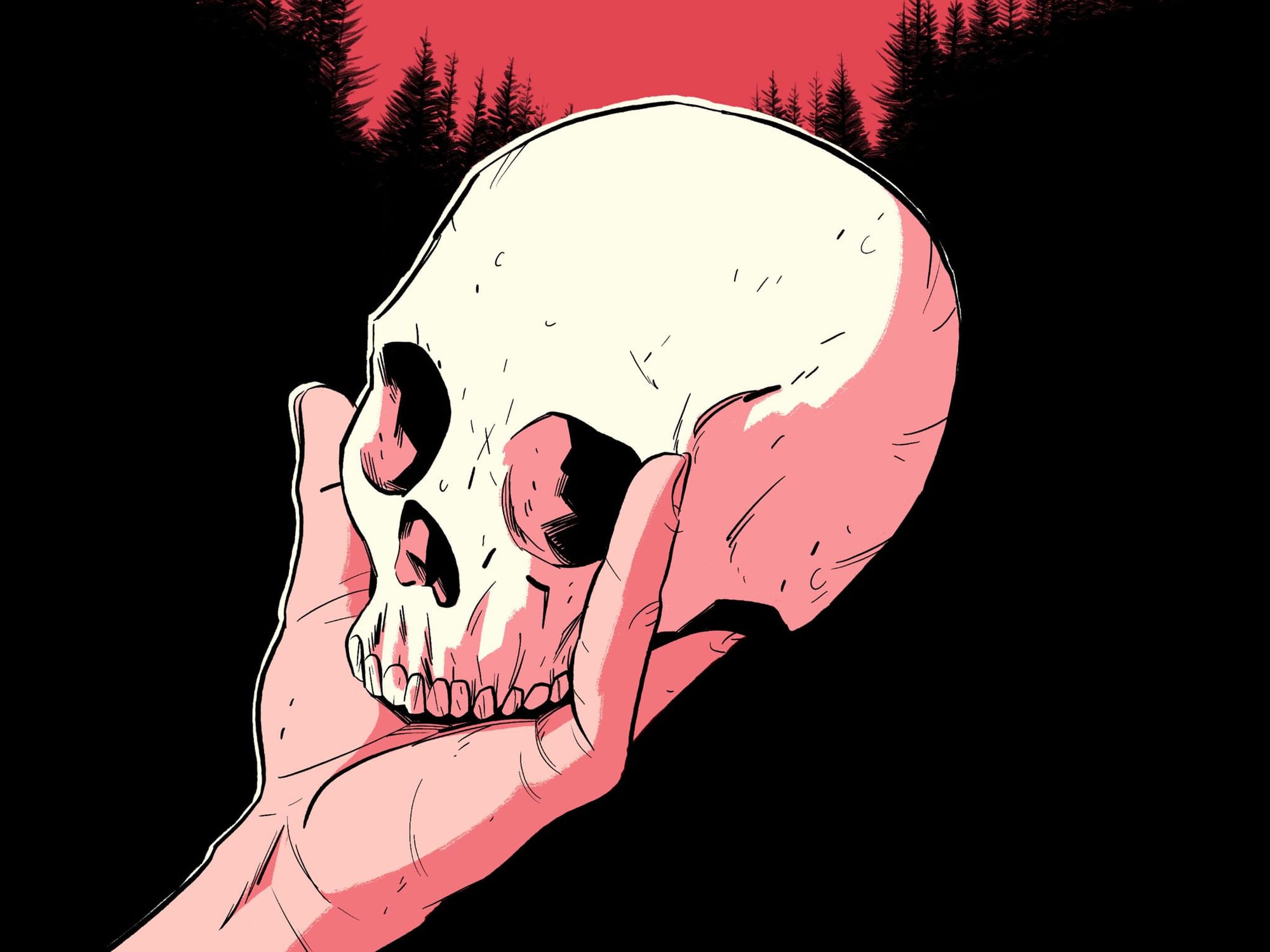
Death in art has been ever-present. The concept of the Memento Mori (remember death / remember that you will die) has been a recurring one in art and philosophy. I imagine if I asked you to think of a piece of art that contained a skull or an hourglass, something has popped into your head. Artists have always been morbid little goths, is what I'm saying.
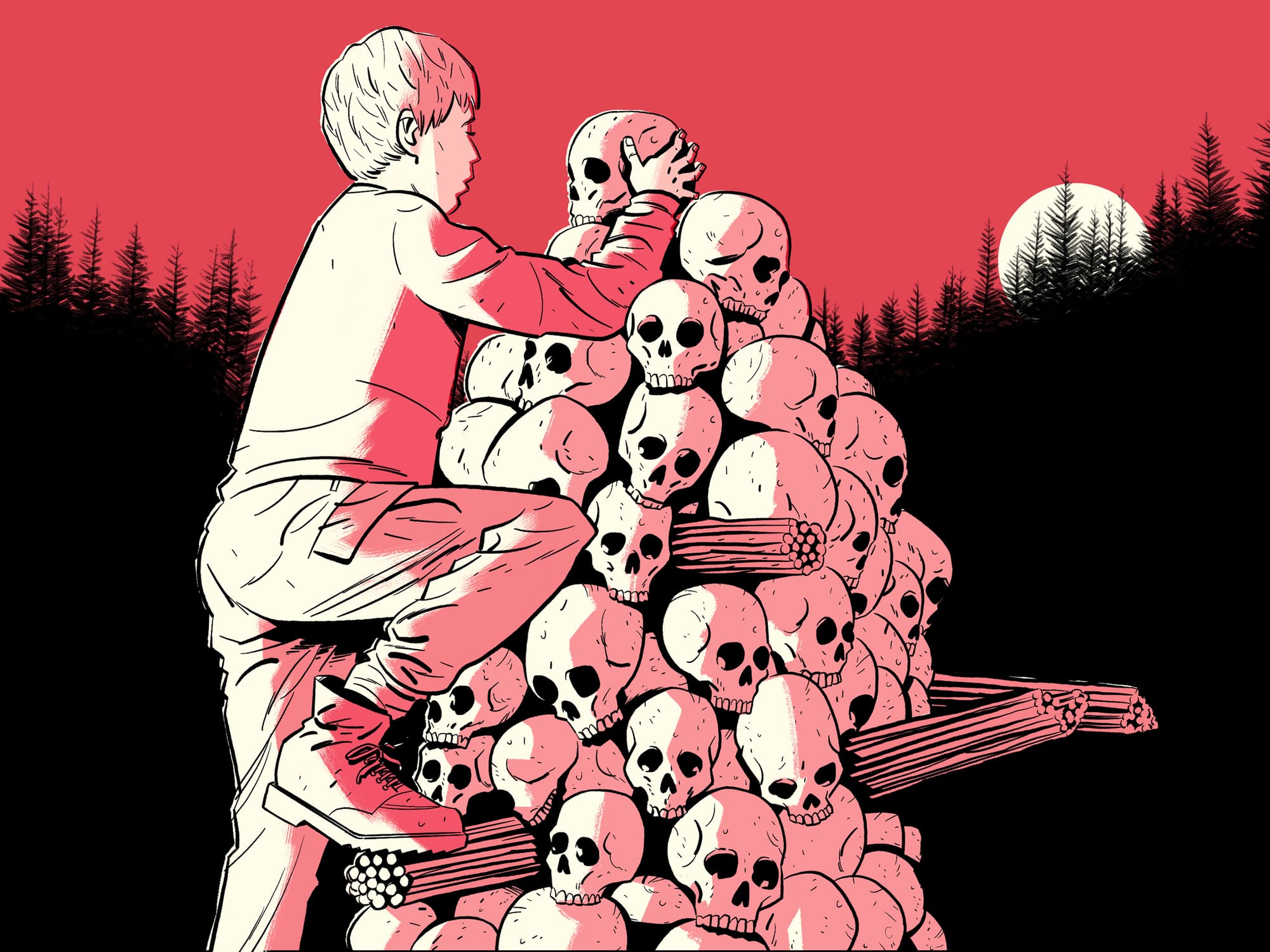
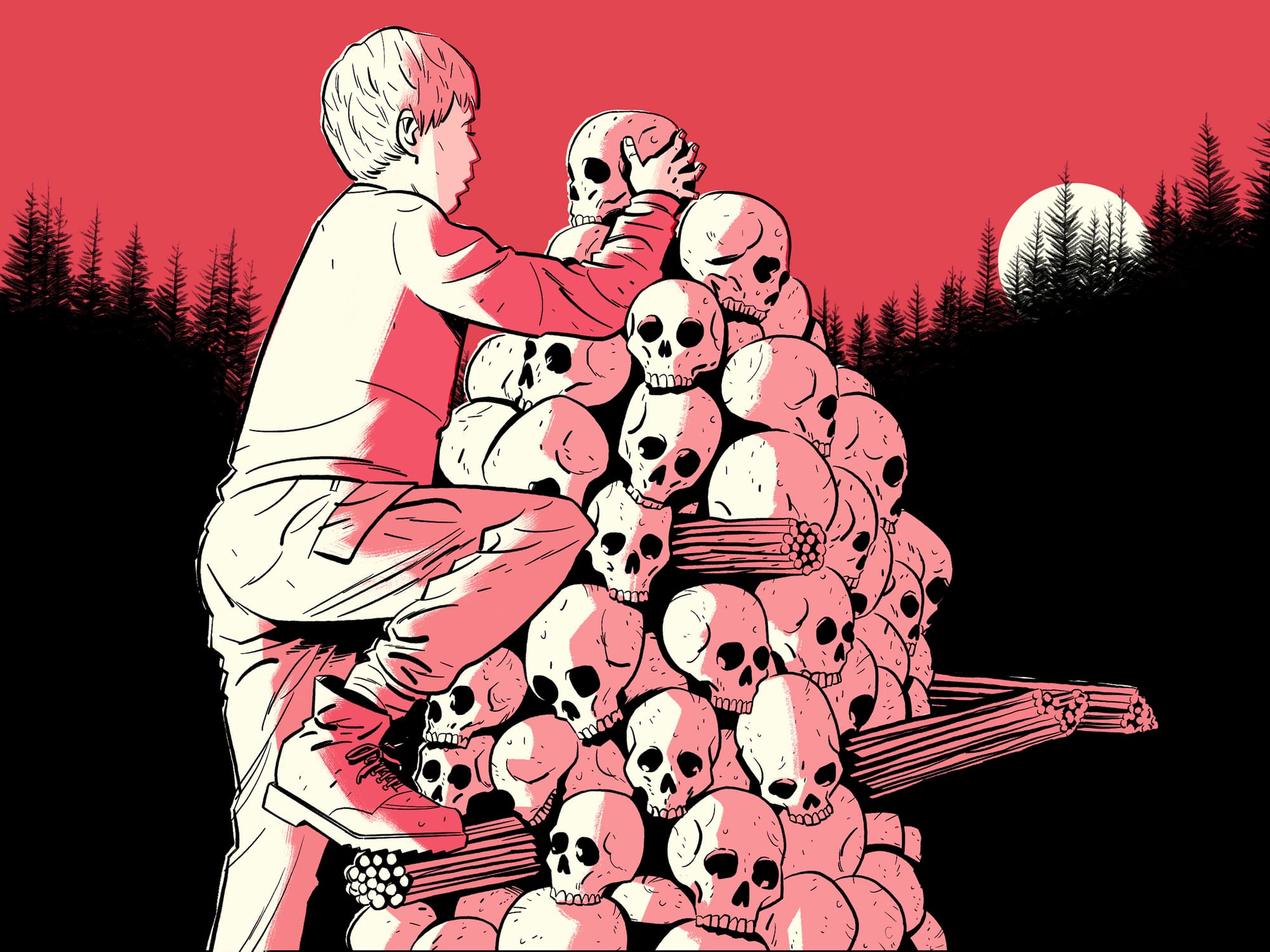
Dr. Ian Kelson’s The Bone Temple (c. 2014. Human remains, twine, wood), in the tradition of Trench and Plague Art, invites us to ponder the inevitability of death. Our own, yes, but also that of our friends, family, lovers and enemies. In the end, no matter what we do, our stories are all ending the same way.
“There are so many dead. Infected and non-infected alike. Because they are alike.” - Dr. Kelson (28 Years Later)
A memorial, a monument, a structural wonder, a sculpture, a work of art, something to do... It is all of the above. Like the pyramids, cairns, steles, kerbs and other megalithic structures before it, it is part of a historic human desire to ritualise, acknowledge and dignify death.
“Every skull is a set of thoughts. These sockets saw and these jaws spoke and swallowed. This is a monument to them. A temple.” - Dr. Kelson (28 Years Later)
Kelson's Bone Temple is his ode to humanity. The good, the bad, the blood-vomiting ugly. He lives among these bones. Reminded daily of his own mortality and that all of this - the beauty and the horror - will pass. Acknowledging death is to also remind yourself of what you are living for. Mere survival isn't enough for Kelson. He is searching for a reason to live. At the end of the world, he has invited poetry into his life and in doing so appears to have retained his kindness, humour and, crucially, humanity.
Compare this approach to the way death is treated by the seemingly bucolic, if parochial, community on Lindisfarne. There, a collection of graves marked by wooden crosses are erected at the edge of the town limits - next to the gate that leads to the causeway that, in turn, leads to the mainland. Here, death is relegated to where it can be ignored. Its purpose? To serve as a warning. A cautionary tale: If you leave here and get stuck on the mainland, no-one is coming to get you.
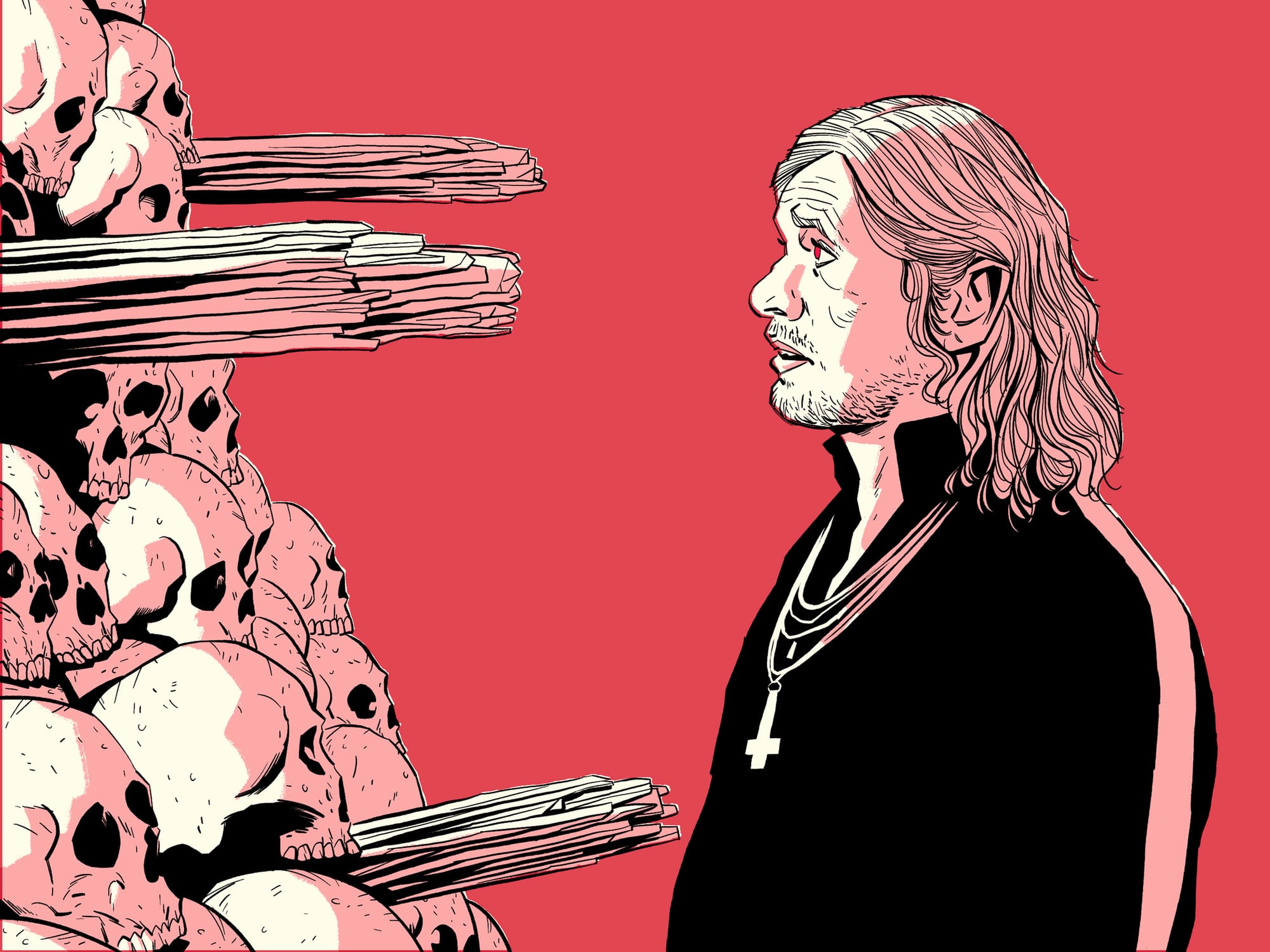
“You were thinking that you’ll never hear another piece of original music ever again. Read another book that hasn't already been written, or see a film that hasn't already been shot.” - Selena (28 Days Later)
Zombie films have always been about death. Or rather, the zombies themselves have always represented death. They may be slow, they may be outsmarted or kept at bay, but they will get you eventually. Around that central metaphor, writers and directors have used this framework to explore various other themes. Throughout the late 20th Century, counter-cultural directors like Romero used them to critique the Vietnam War (Night of the Living Dead), consumerism (Dawn of the Dead), and masculinity in the Reagan era (Day of the Dead). By the end of the 90s, however, the sub-genre had become something of a joke, being deployed in playful splatter-comedies like Peter Jackson's Braindead or offbeat indie fare like Dellamorte Dellamore.
It wasn't until Danny Boyle and Alex Garland's 28 Days Later, in 2002, that the sub-genre was injected with a new lease of rage-induced life. A chimera of various post-apocalyptic fiction such as Wyndham's Day of the Triffids and Romero's original Dead trilogy, while playing with notions of a quarantined, isolated UK in the wake of public health scares like BSE (mad Cow Disease) and foot-and-mouth disease. It's in the past three decades, however, that 28 Days Later has thematically come alive. For some, it's in the images that came out of the War on Terror and the forever wars in the Middle East that the film found it's reflection. For others, the film made the most sense as part of an Isolationist Brexit canon.
Ultimately though, it was COVID that reignited the film's enduring relevancy. In the pandemic lockdowns of 2020 and 2021, Cillian Murphy's haunting Godspeed-backed walk through a deserted Central London just became everyone's Tuesday. A sequence that could only be achieved using dogshit DV cameras, shooting at 3am, and an army of runners politely asking homeward-bound clubbers to stay out of shot - could now be recreated by anyone with a camera.
The film sparked an outbreak of zombie content in the 2000s and 2010s. But zombie content that was seemingly no longer interested in the progressive counter-cultural concerns of its forebears. Zack Snyder's Dead films and The Walking Dead comic/TV series traded in a sort of conservative nihilism. Prepper porn with soulless NPC target practise. Any kindness or gentility in these worlds is punished if not by the zombies themselves, then by other humans. Human beings are the real monsters you see. It is the law of the jungle. Survival of the fittest. Might is right. Kill or be killed. Peace through strength.
"The fundamental definition of humankind for neoliberalism is this: We are self-centered, selfish, egotistical bastards. We survive on the demise of others. We leave the weak behind. If you want to be a winner, you should leave behind the losers, and so on, which is very, I think, integral and central to the American way of life, if we can say that, or capitalism. That particular definition is a threat and is a very serious attack to humanity." - Ece Temelkuran
This, fair or not, is the legacy of 28 Days Later. A film which has been misread and misinterpreted by it's successors as being reactionary, hostile, and conservative. The strange beauty, melancholy, and hope of the film is often forgotten by it's fans and critics alike. Instead, it is the anger, provocative violence and doomerism that they remember.
"It's not all fucked." - Jim (28 Days Later)
We now apparently live in a world in which "might is right" and "law of the jungle" are phrases that get talked about on the news while discussing geo-politics. The mirage of "the international rules-based order" has been revealed to be just that - a mirage. It always was of course. People have just stopped pretending.
I'm tired of it. I'm tired of our art and culture presenting us with stories that are mirrors of the worldviews of powerful sociopaths under the guise of "realism". I want to see alternative philosophies. I want to see what happens when societies collaborate and value empathy and don't just retreat into fear.
I think the new 28 Years Later films want that too. The two sequels we have so far (the final entry is either in production or in limbo depending on what you read) appear to be grappling with this legacy. Spirited ripostes to the prevailing trends of zombie (gag) content (retch).
In both films we are presented with three distinct philosophical responses to death:
- On Lindisfarne, we have Fear - a colony of isolationism and regressiveness. A parochial, gated community that acts as a microcosm of a post-Brexit Britain. Still worshipping the Queen and recreating previous hierarchical structures.
- With The Jimmies, we have Strength - a nomadic gang who keep death at bay with violence and cruelty. Death cannot come for them, for they are death. An outgrowth of fear, that has rotted and twisted the soul.
- With Dr. Kelson, we have Acceptance - someone who has embraced death and in doing so, his lack of control over it. In this acceptance, life isn't just about survival. Life - all life - becomes precious. He doesn't see the Infected as soulless monsters but as sick people who deserve understanding and treatment.
"Greed has poisoned men’s souls, has barricaded the world with hate, has goose-stepped us into misery and bloodshed... We think too much and feel too little. More than machinery we need humanity. More than cleverness we need kindness and gentleness. Without these qualities, life will be violent and all will be lost... You, the people, have the power to make this life free and beautiful, to make this life a wonderful adventure." - Charlie Chaplin (The Great Dictator)
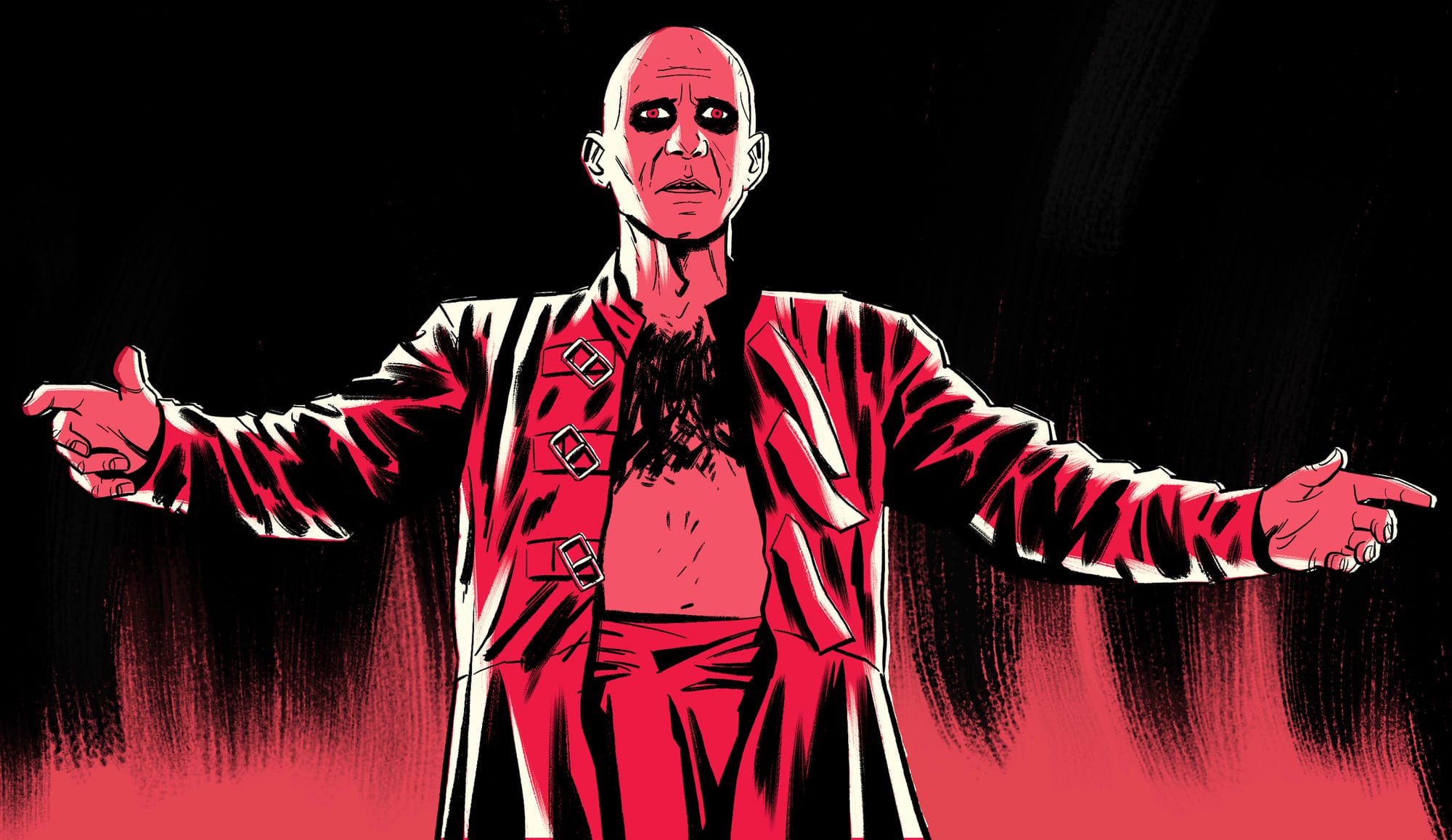
When Dr. Kelson stages Old Nick (c. 2029. Live performance with mixed media), a one-night-only cultural event, we get the distinct impression that before pursuing a career in medicine, Kelson was a keen theatre kid.
The Bone Temple, lit by candles, torches and lamps. A topless figure, painted in black and white like Death from The Seventh Seal (or, if you'd prefer, Bill & Ted's Bogus Journey), lip syncs and interpretive dances to the tune of Iron Maiden's Number of the Beast. He throws a torch and lights a ring of fire that encircles his audience before blowing powdered drugs into their faces. For the climatic finale, wearing flame-retardant clothing, he wields a fire-staff with cages on both ends filled with charcoal embers that he twirls around to create dizzyingly beautiful pyrotechnics.
It's part fire-poi, part lip-sync-for-his-life, part Beltane dance, part metal gig, part Satanic ritual, part Kabuki theatre. It feels in conversation with the folk horror, Pagan traditions of this island.
You can see the impact of this piece of culture on the faces of the younger Jimmies. It's like nothing they've seen before. It has returned wonder, awe, and magic to the lives of these child soldiers. Do they believe this ageing GP is really the Devil? Or are they suspending their disbelief momentarily so that they can believe in something bigger than them, than the daily horror of their lives?
Sadly, the pyrotechnics are not the true finale of the performance. Kelson as Old Nick returns to relay pre-agreed proclamations on behalf of the central villain of The Bone Temple - Jimmy Crystal. Here, we see the dark side of how art can be wielded and weaponised in times of crisis.
Propaganda is the only form of art that fascists particularly understand. They don't see the point of art if it is not being used as some form of population control. It's why they like AI so much. Art without the pesky artists and their ideas. Art as conclusion, not exploration. As answer, not question.
Is Jimmy Crystal a fascist? He's certainly an authoritarian cult leader obsessed with aesthetics. And a monster. So let's say fascist-adjacent, at minimum. He has surrounded himself with younger, subservient acolytes - those similarly traumatised and left without a home, or community, or guidance by the Infected-ravaged land. As a way of ensuring obedience, he has concocted a new religion, or mythology, that places him as the rightful leader of what he calls his "Fingers". A mythology constructed out of half-remembered parts of The Bible, the Teletubbies, the Power Rangers, and whatever else he can twist and misshape from his childhood. One aesthetic influence - Jimmy Saville - doesn't need much perverting, though Crystal, existing in a frozen point of UK culture, wouldn't know that. This is culture as toxic nostalgia. Not creating something new out of it, but regurgitating something old in a way that resembles a mutated, grotesque version of the past. Storytelling as a form of misinformation and control.
Unrelatedly, did you see Paramount Studios bought Warner Brothers?
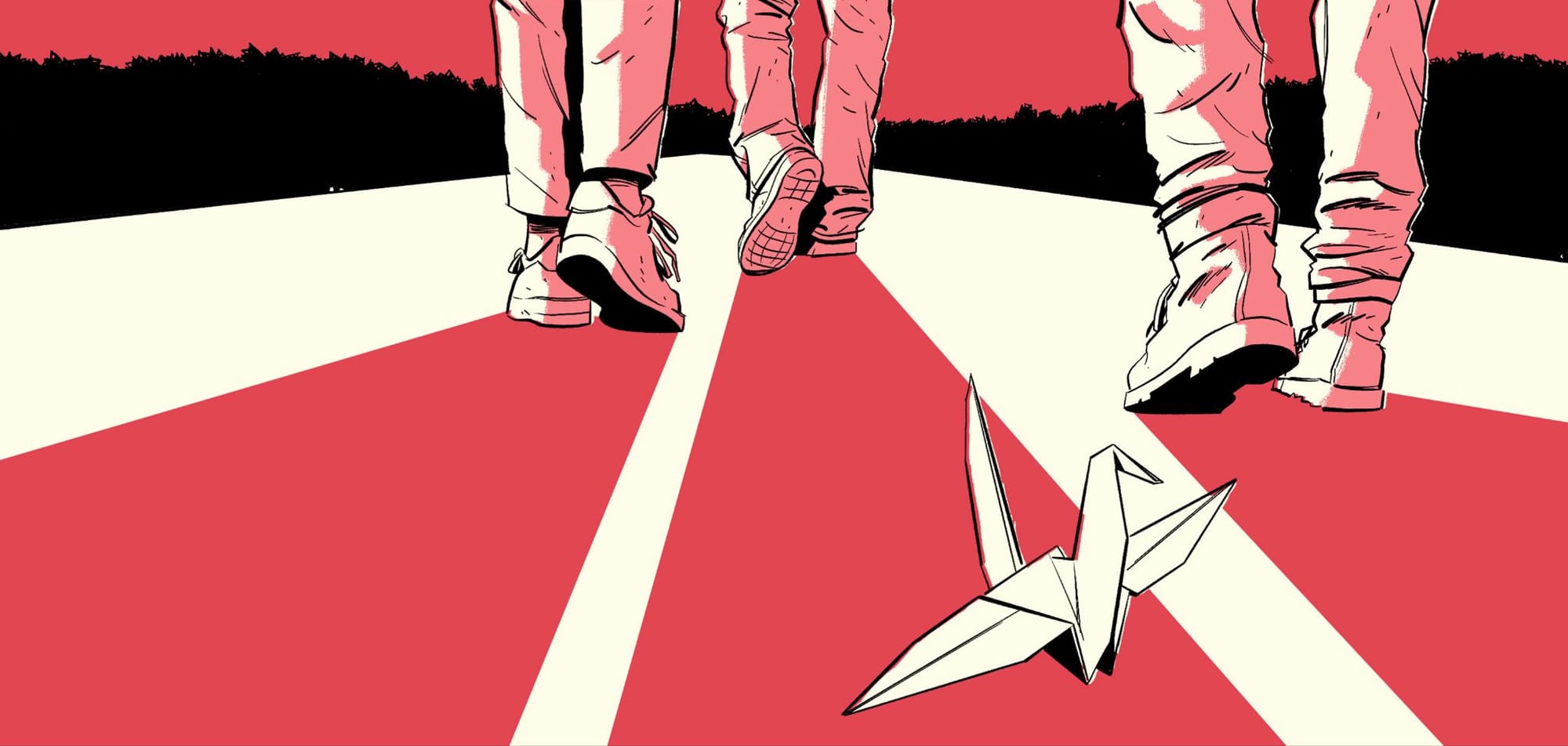
"Just walk with me a little longer." - Raymond Garraty (The Long Walk)
Humanity's march towards death was also something of a theme in last year's The Long Walk. An adaptation of a Stephen King (née Richard Bachman) novel ostensibly about the draft and death of America's youth in the Vietnam War. But it works as a (very) broad metaphor for the perseverance of the human spirit under capitalism.
In this alternate near-future 1970s dystopia, the country's economic growth is somehow (don't think about it too hard, it works best as a fable) tied to an annual competition known as The Long Walk. Fifty teenage boys must walk at a constant rate of three miles per hour until there is only one left standing. Fall below that rate, try to escape, or receive three warnings, and you die. It's a zero sum game.
"Each year after the event, there's a spike in production. We have the means to return to our former glory. Our problem now, is the epidemic of laziness. You boys are the answer. The Long Walk is the answer. When this is broadcast for all the states, your inspiration will continue to elevate our gross national product. We will be number one in the world again!" - The Major (The Long Walk)
The incentive, in this system, is to look out for number one. Be selfish. Never help your fellow walkers, sabotage them, trick them, do whatever it takes to fuck them over to ensure you win. So: late capitalism, basically.
But that's not what these children do. They make friends. They help each other, offer comfort, and solidarity. Despite these acts of kindness working against their own interests and survival, they insist on doing it until the very end. They reject the system's diktat that they abandon their humanity.
Nothing sums up the shortsighted pointlessness of late capitalism than sacrificing your society's youth on the altar of economic growth by making them walk. An act that is done either to get from point A to point B, or for pleasure - perverted into an act of punishing, life threatening, endurance.
But even here, art and the desire to create, to find beauty in the world, persists:
“Here we have these kids who are economically disadvantaged (few aren't in this world) risking their lives for a shot at a better life and so many of them have a passion or at least an appreciation for the arts that will never be known. Tressler's love for music; Barkovitch and his camera; the drumsticks in Curly's backpack; the book Harkness wanted to write; Rank's colorful origami. All these kids desperate for a way out, knowing they will very likely die, knowing that they can't carry much and so many of them loved their art so much that they brought it with them on this death march. A security blanket, perhaps. A belief in something beautiful.” - Yhara Zayd (from her Letterboxd review)
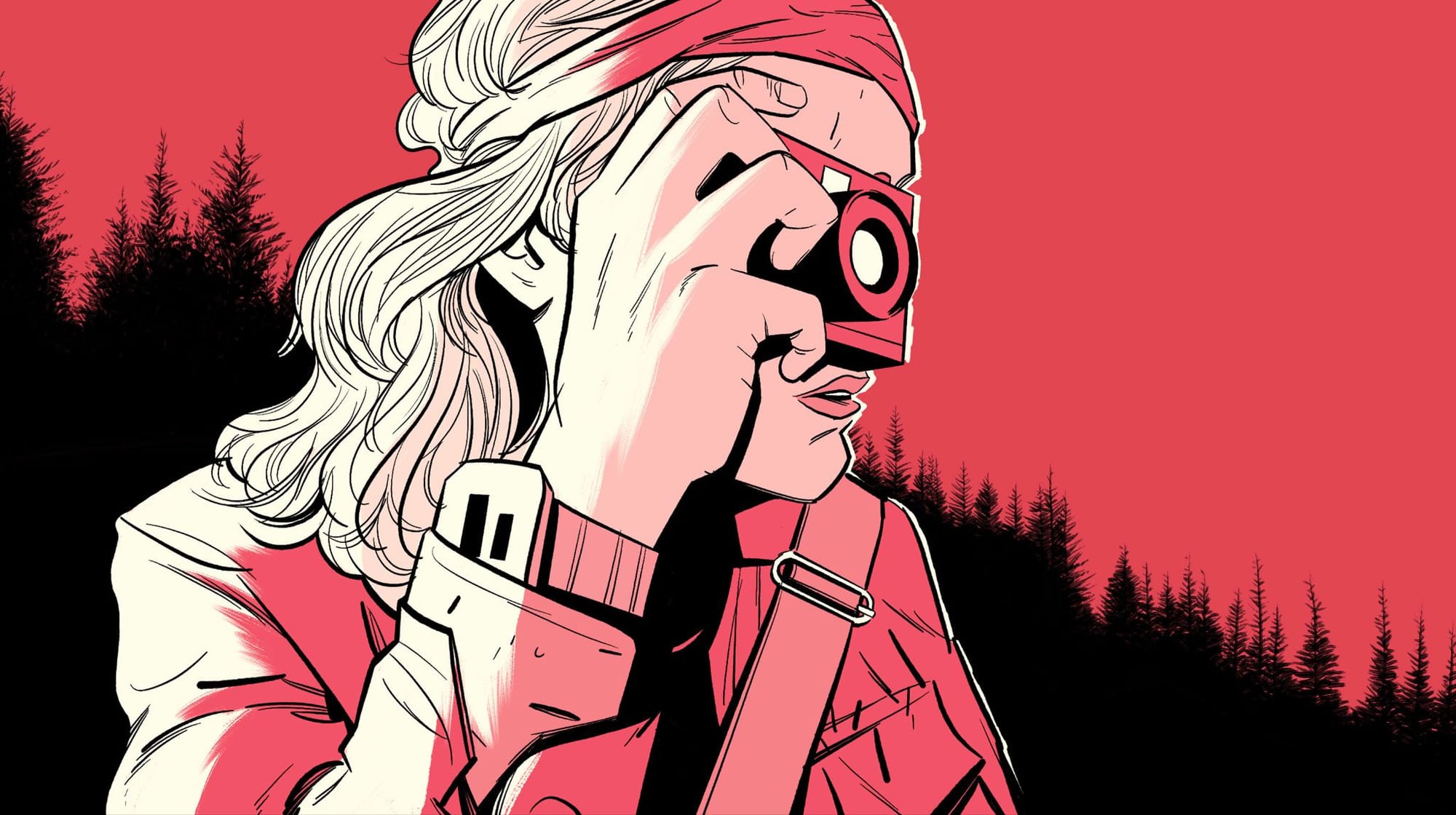
“The object of art is not to make salable pictures. It is to save yourself ” - Sherwood Anderson
“Is your dad silly?” -Isla (28 Years Later)
When Dr. Kelson isn't making or performing art - when he is alone at the end of the day, safely ensconced in his bunker - he listens to music on a wind-up record player. To him, music - culture - is a necessity. Not a luxury. Life isn't worth living without it. He dances. Eventually finding a dance partner in Samson, his Infected friend and patient. We want to share our experiences, our art with others. Share the things it teaches us. The things we've discovered.
I've been finding it hard to make art lately. I've been slowly, very slowly, developing my next graphic novel. A comic about horror and Hollywood. As bombs fly over Tehran right now, this work feels so small, so trivial. A joke. Who needs me to draw stupid stories at a time like this? Global fascism is on the rise, we've been watching a genocide happen in front of our eyes for over two years, and another forever war in the Middle East is now in full swing. Climate collapse is still on the horizon, the rich get richer, the poor get poorer, and AI is poised to make it all so much worse. But would you like to see this drawing I've made?
“This is precisely the time when artists go to work — not when everything is fine, but in times of dread. That’s our job [...] I know the world is bruised and bleeding, and though it is important not to ignore its pain, it is also critical to refuse to succumb to its malevolence.” - Toni Morrison
Self-doubt and uncertainty of the artist's role while the world ends is something a lot of creative people feel right now. The Bone Temple has emboldened me though. It's time to add some more roles to that Wall of Acceptable Jobs on Lindisfarne.
Art is resistance. As the majority of our media organisations, news outlets and politicians refuse to present us with an honest assessment of the present or hopeful visions for the future, it is the artists' role to be braver, louder, and more uncompromising. Don't listen to those cowards at the Berlinale last month. Or the disingenuousness of Richard Osman and Marina Hyde. Art is always political. Even when it isn't.
Would you like to see this drawing I've made?
The thing is, if anyone asks me that question - I would. I would like to see that drawing. I need art, music, poetry and beauty more than ever right now. I have to hope that other people feel the same. We need to daydream, to imagine, to remember death.
Don't let the arseholes take art away from us.
The world may come to an end, but love and music will endure.
“Our poems, like milestones, must line the road” - Nâzım Hikmet
Thanks for reading my first post of 2026! Sorry it's been so quiet here. This specific piece has been percolating for a while now - since the first film. I hope you liked it and felt it was worth the wait.
I'm hard at work developing my next graphic novel, but also researching a non-fiction comic that, I think, will be around 10-15 pages long. The plan is to share it here and on social media before printing it as a zine. I'm trying to strike a balance between making political, reactive comics that help me feel less powerless, and the more personal poetry and fiction projects that feel more indulgent but are just as important (see everything above).
I've currently got three subjects I'm keen to make non-fiction comics about - hopefully I'll be able to get to all of them this year but we'll see. It's a lot of work, and no-one is paying me to work on these, the graphic novel, the poetry comics, or the newsletter. So it all needs to fit in around paid work.
If you'd like to help me focus more on the non-fiction comics, a paid subscription to this newsletter would be one way to help make them more sustainable. Even a small donation would be useful. But only if you are able to. These newsletters will always be free to read.
Annual subscribers will receive any new zines I make in the year of the subscription. No guarantee I'll make something every year but I try to.